Design Considerations for Hot-Dip Galvanizing: Threaded Assemblies
Best design practices for corrosion protection recommend avoiding direct contact between dissimilar metals whenever possible. When different metals touch, galvanic corrosion can occur—shortening the lifespan of one or both materials. Zinc, which coats hot-dip galvanized fasteners, naturally sacrifices itself to protect most other metals. That’s why, for maximum durability and long-term corrosion resistance, it’s always recommended to use hot-dip galvanized fasteners with galvanized structural assemblies.
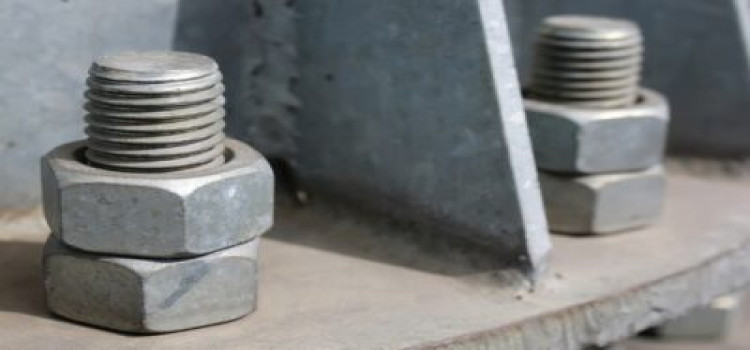
Best Practices for Galvanizing Studs, Bolted Assemblies, and Threaded Parts
For optimum corrosion protection and ease of assembly, industry best practices recommend sending studs and bolted assemblies to the galvanizer in a disassembled state. Masking threads on pipes or fittings to prevent galvanizing is challenging and often impractical. Instead, the recommended method is to clean and tap threads after galvanizing.
In some cases, anchoring devices—such as threaded rods and anchor bolts—are specified to be galvanized only in the threaded areas or in the sections exposed above ground. However, this selective galvanizing can be more expensive due to additional handling. Complete galvanizing is often the most cost-effective and durable solution, especially for items anchored in concrete.
Manufacturers of threaded parts follow specific procedures when preparing items for hot-dip galvanizing:
-
Material Selection: Low-carbon bars are preferred, as high carbon or high silicon content results in heavier, rougher coatings on threads.
-
Surface Preparation: Hot-formed heading or bending should be cleaned at the manufacturing plant to remove scale before threading, preventing over-pickling during scale removal.
-
Tooling: Sharp tools are essential. Damaged or worn tooling can create ragged threads that open during pickling and galvanizing or increase bolt diameters. Frequent checks are important for long production runs.
-
Thread Specifications: Standard-sized threads are cut on bolts, while nuts are retapped oversized after galvanizing to ensure proper fit.
-
Oversizing for Larger Threads: For threads over 1.5 inches (38 mm), it is often more practical—if design strength allows—to cut the male thread 0.031″ (0.8 mm) undersize before galvanizing. This allows a standard tap to be used on the nut, as recommended in ASTM A563 (Specification for Carbon and Alloy Steel Nuts).
By following these best practices, manufacturers and galvanizers ensure that galvanized fasteners meet both structural and durability requirements, delivering long-lasting performance in even the harshest environments.
Sign up to receive the latest news from Hadid Galvanizing
